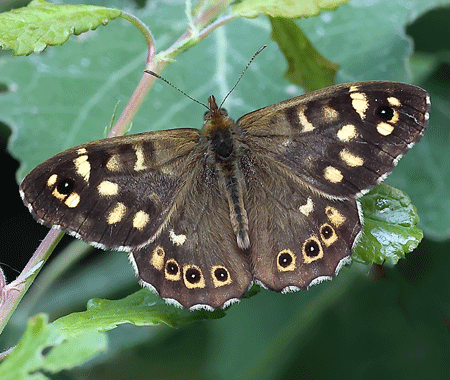
The Speckled Wood is a common butterfly in the UTB area. One could make an argument that this is the UK's only true woodland butterfly, with our other woodland species being confined to more open areas of woodland habitats, such as rides, glades, or coppiced areas.
As an adult this species can be seen and recorded from late February to early November. There are a number of reasons for this unusually long flight period.
Firstly, it is the UK's only butterfly that regularly spends the winter in two different life stages (larva or pupa), giving the species a staggered appearance in the Spring. Secondly, the variable microclimates in woodland cause the larvae to develop at different rates and some springtime larvae enter a period of summer rest (aestivation) instead of producing adults that year and start to feed again in the autumn before pupating and hatching out in the following spring.
This flexible lifestyle and the fact that it can live in large deciduous woods, young conifer plantations, spinneys, copses, wooded lanes, hedgerows, shaded footpaths, patches of scrub, and shaded gardens, are some of the reasons that this charismatic and beautiful butterfly can be found close to every UTB member. The male's dual habit of guarding a shaft of sunlight from all comers, and of patrolling for newly hatched females, makes this and easy species to spot and record.
The adult flight period chart shows an interesting change between the two recording periods. In general, there has been a shift to earlier emergence. In the 2005 to 2014 period there is a small peak in the second half of June followed by a much larger peak from mid-August to mid-September. In the 2015 to 2024 period the first peak is slightly earlier in mid-June, and the second peak is twice as long and shows three sub-peaks: the third week of July, early August and late August/early September. Extra recording activity is likely to have an effect here, but climate warming is also likely to be a major factor. Compared with the charts shown here, many texts show a small peak at the end of October and a more pronounced peak in April/May (including our atlas covering 1987 to 2000). How much this reflects true changes to this butterfly's flight times due to climate warming or changes in its habitat, rather than butterfly recorders habits, is hard to be sure of.
The distribution maps for the two recording periods (2005-2014 and 2015-2024) show a small increase in the number of 2 km squares that this species was recorded in, but this can probably be accounted for by an increase in recording effort.
Although this butterfly has gone through massive population losses and subsequent recolonisation in the past, with climate warming and the current popularity of tree planting, the future of this butterfly in the UTB area seems secure.